
Projected vs Actual Release Date
A projected release date is a current calculation. It is not a promise that the person will walk out at that exact time. The actual release date is the date and time custody ends, and it can be recorded by a sheriff booking/release entry, a CDOC offender record, a parole record, a court order, a VINE custody-change notice, a BOP locator result, or another receiving agency record. In Sedgwick County, the first sorting question is whether the person is in local county custody, CDOC state custody, federal custody, immigration custody, or post-release supervision.
For local Sedgwick County jail matters, the sheriff and court are the controlling sources. The county site did not show an official release-date calculator, current roster, 24-hour release feed, or 72-hour release feed during the research pass. For state-prison matters, the public starting point is the CDOC offender search. The CDOC result may show status, facility or non-custody status, parole-board links, photos, and date fields. The exact field label should be preserved because a parole eligibility date means the person may be considered for parole, while a discharge date relates to the end of sentence or supervision.
Find a Sedgwick County Release Date
Use this order so the lookup follows the record source instead of guessing from a name search. Sedgwick County, Colorado shares a county name with Sedgwick County, Kansas, and search results can mix the two. Use Colorado sources, Julesburg sheriff contacts, Colorado Judicial Branch, CDOC, Colorado VINE, BOP, or ICE depending on the custody type.
- Decide whether the case is a local jail case, a CDOC state-prison case, a federal BOP case, an immigration detention case, or a supervision case.
- For a local jail release, contact the Sedgwick County Sheriff's Office at 970-474-3355, 1-888-344-3355, or 970-474-2008. Ask for release date/time, release reason, bond status, court case number, and whether the person was released to the community or transferred.
- Search the Colorado Judicial Branch docket by Sedgwick County or Sedgwick Combined Court, party name, case number, and date range. Look for bond, sentence, dismissal, warrant, mittimus, probation, or case-closure entries.
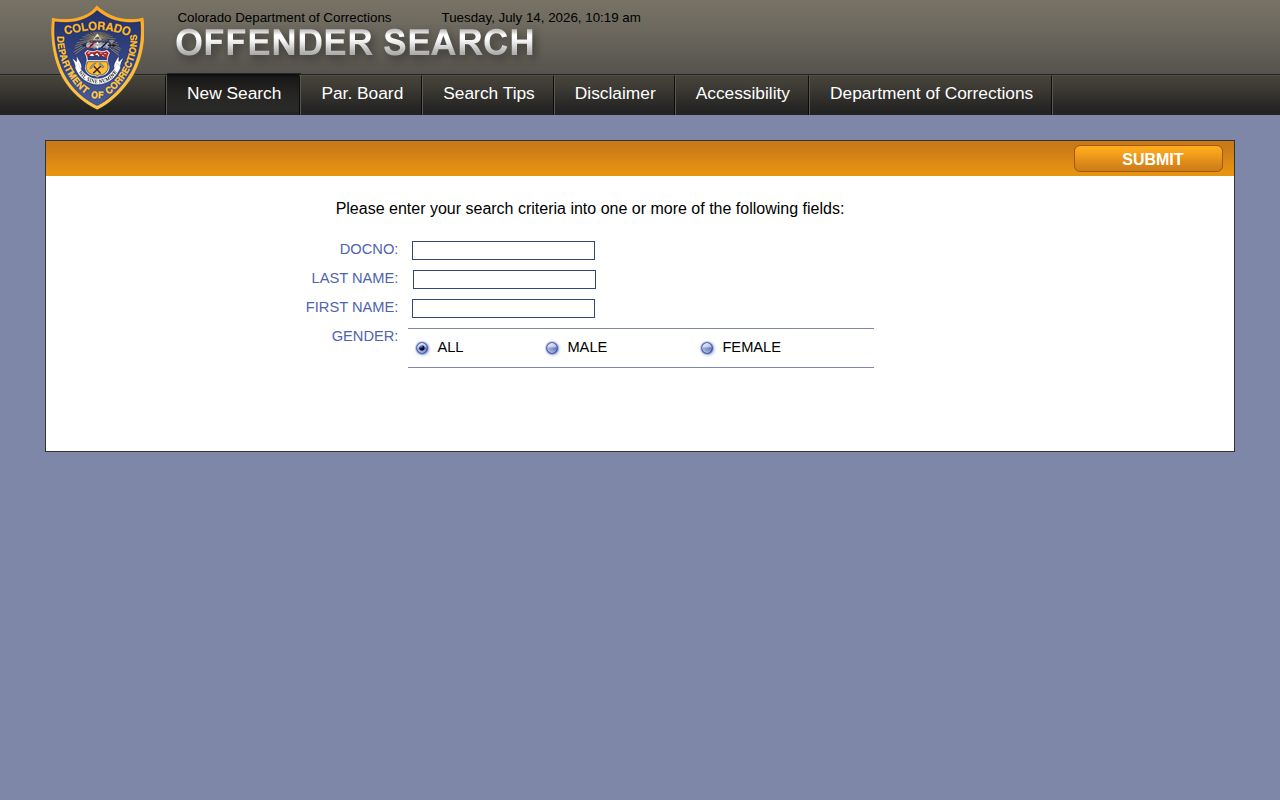
- For a state prisoner, search CDOC by DOC number when possible. If no DOC number is known, use last name, first name, and gender, then compare identifiers before relying on a match.
- Open the CDOC record and write down the exact date label, such as parole eligibility, mandatory release, projected release, parole date, or discharge date. Do not merge those terms.
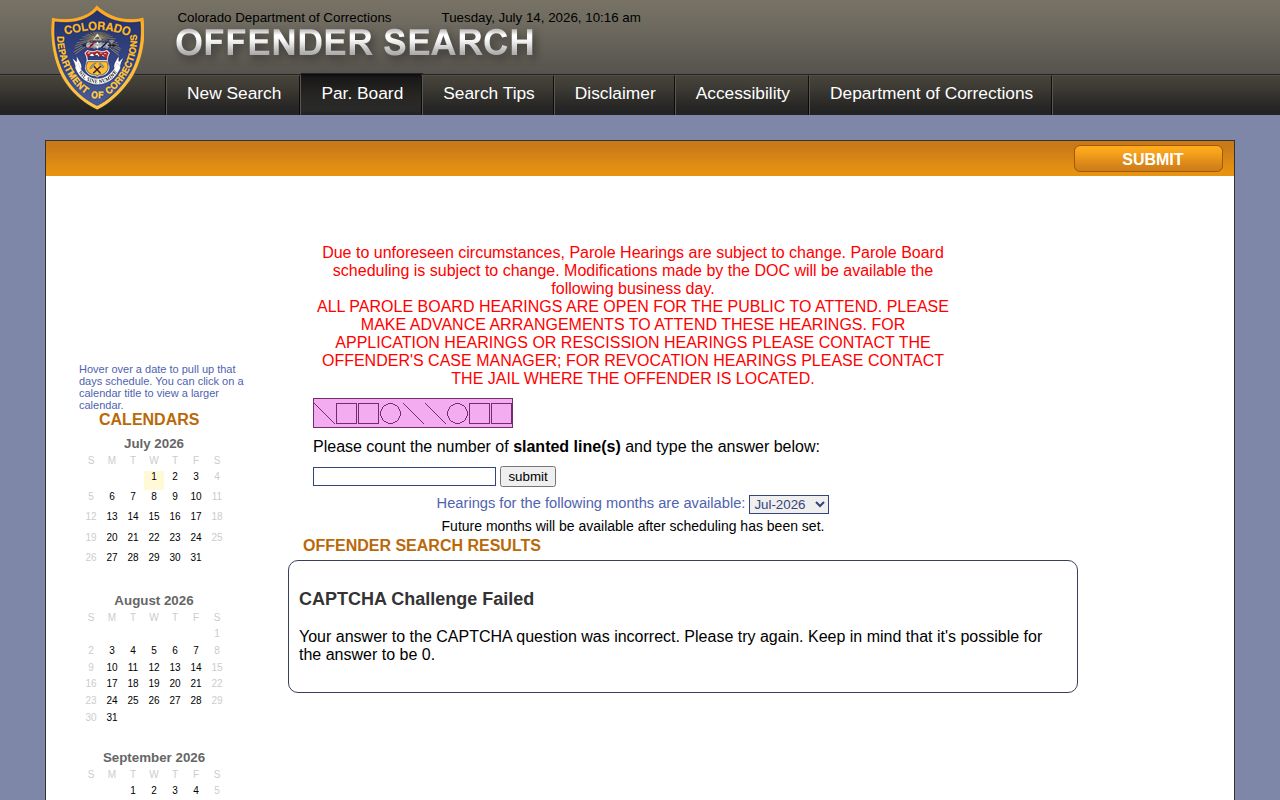
- If parole timing is involved, check the parole-board calendar and contact Adult Parole, CWISE at 800-426-9143, or the Sterling Parole Office at 970-522-7815.
- Use Colorado VINE for custody-status notification while a person is still visible in the VINE system. For older or disputed records, use the sheriff, court, or CDOC custodian.
CDOC Date Labels Must Stay Exact
Colorado's public state-prison records can include several time-computation concepts. A Sedgwick County user may be asking "when do they get out," but the record may answer a narrower question. A parole eligibility date is the earliest or current point at which parole consideration may occur under the person's sentence rules. A mandatory release date is closer to a custody-release endpoint, but it can still interact with parole, detainers, sentence changes, or other legal conditions. A projected release date is a calculation based on the current data available to CDOC. A discharge date is different again because it points to the end of sentence or supervision control.
| Field or source | What it can tell you | What it does not prove |
|---|---|---|
| Parole eligibility date | The person may be eligible for parole consideration under sentence rules. | It does not prove the parole board granted release. |
| Mandatory release date | A sentence-computation endpoint that may control release from physical custody. | It does not necessarily mean all supervision ends that day. |
| Projected release date | CDOC's current calculated release estimate if that label appears on the record. | It is not immutable and can change with credits, discipline, orders, or holds. |
| Discharge date | The sentence or supervision obligation is ending or has ended. | It is not the same as the first day out of prison on parole. |
The safest page note is "the public CDOC search shows" followed by the exact label. CDOC's disclaimer tells users to contact CDOC to confirm all information because database information may sometimes be inaccurate. That is especially important where the result is being used to correct a record, plan for pickup, understand parole, or compare a court sentence to a prison calculation.
Colorado Earned Time and Good Time
Colorado release-date math depends on offense date, offense type, sentence structure, credits, parole eligibility, and current law. C.R.S. 17-22.5-405 governs earned time for many modern sentences. It allows earned time, not to exceed ten days for each month of incarceration or parole, when the inmate demonstrates progress in required categories. The statute also allows up to twelve days per month for certain class 4, class 5, class 6, level 3 drug felony, or level 4 drug felony sentences when statutory conditions are met. CDOC may grant, withhold, withdraw, or restore earned time based on the person's record.
C.R.S. 17-22.5-301 addresses good-time rules for older sentence categories. Because Colorado sentencing law is offense-date-specific, a Sedgwick County page should not give a simple formula such as "subtract X days per month" or "everyone serves one percentage." Old sentences, new sentences, violent-offense sentences, parole revocations, concurrent sentences, consecutive sentences, and sentence amendments can compute differently.
Truth-in-sentencing rules add another layer. Colorado HB24-1127 changed parole eligibility for specified violent crimes committed on or after July 1, 2024. The legislative summary says those offenders must serve at least 85 percent of the imposed sentence before parole eligibility, and that certain repeat crimes-of-violence histories can require service of 100 percent. The summary also notes that prior law used a 75 percent framework for some specified violent offenders. The correct statement is case-specific: offense, date, sentence, and criminal history control.
Why a Projected Release Date Changes
A projected release date can move for legal and administrative reasons. Some changes shorten the expected custody period, while others delay release or convert release into a transfer. The table below describes the common change points without treating any one rule as universal.
| Factor | How it affects the date | Who confirms it |
|---|---|---|
| Earned time or good time | Credits may reduce the time remaining, or credits may be withheld, withdrawn, or restored. | CDOC for state sentences, sheriff and court for local jail sentences. |
| Discipline or misconduct | Can change credits, parole plan status, rescission risk, or release timing. | CDOC, parole office, or sheriff depending on custody type. |
| New warrant or hold | Can delay release or turn a release into transfer to another agency. | Sheriff, court docket, receiving agency, BOP, ICE, or CDOC. |
| Court order or sentence amendment | Can change custody authority, jail credit, consecutive terms, or dismissal status. | Sedgwick Combined Court or the sentencing court. |
| Parole-board decision | A hearing may grant, deny, defer, revoke, rescind, or continue parole consideration. | CDOC offender record, parole-board calendar, Adult Parole, or CWISE. |
| Transfer | The person may leave Sedgwick County custody without being released into the community. | Sheriff release record and receiving agency. |
County Jail Dates Are Local
A Sedgwick County jail sentence or bond release is not calculated by the CDOC public offender search unless the person was transferred or sentenced to the state prison system. For a local jail sentence, ask the sheriff for the booking number, booking date, release date/time, release reason, bond status, transfer destination, and whether the record includes a booking photograph. Check the court docket for sentencing, jail credit, bond entries, dismissal, warrants, or a mittimus.
The county does not state a public web retention window for jail releases because no public online roster or release feed was found. That means same-day release timing should be confirmed by phone, and older release proof should be obtained through a records request or court-record request. If the release reason was transfer to CDOC, BOP, ICE, or another agency, the Sedgwick County release record should identify the destination, while the later release date belongs to the receiving system.
Parole Calendar and Release Timing
The parole board can change a user's expectations even when a sentence calculation seems clear. CDOC's parole-board calendar displays monthly hearing calendars and says hearings are subject to change. A scheduled hearing is not a release grant. A grant may still depend on parole plan approval, detainers, rescission risk, or other conditions. A denial or deferment means the community-release path remains different from the date a user may have calculated from sentence length alone.
Confirming a Release Date
Confirmation should come from the office that created the record. For a local Sedgwick County jail release, that is the Sedgwick County Sheriff's Office or the court record explaining the legal authority for release. For a state-prison projected release date, use CDOC offender search as the public lead and contact CDOC, Adult Parole, CWISE, or the Sterling Parole Office when the date is disputed or connected to parole. For a federal sentence, use the BOP inmate locator. For immigration custody, the ICE locator is custody-location oriented and should not be treated as a county release-date calculator.
Colorado VINE can provide custody-status and release notifications when the person is visible in the VINE system. Registering before a release is often more useful than searching after a record has aged out. For detailed instructions, use the VINELink Check page. Pair any VINE alert with the sheriff, CDOC, court, BOP, or ICE record that controls the actual custody event.