
Parole vs Probation in Sedgwick County
Parole and probation often get used as if they mean the same thing, but in Sedgwick County they point to different records and different supervising authorities. Parole is usually the community-supervision part of a Colorado state-prison sentence. The public lead is the Colorado Department of Corrections offender search, followed by Adult Parole contacts if a person appears to be released from prison but still under sentence control. Probation is imposed or managed through the court system. The public lead is the Colorado Judicial Branch docket search for Sedgwick County or Sedgwick Combined Court, then a court records request or probation-department contact when the public docket is not enough.
| Question | Parole | Probation |
|---|---|---|
| What it usually follows | Release from a CDOC prison sentence or mandatory parole period. | A court sentence, deferred judgment, revocation case, or supervision order. |
| Where to start | CDOC offender search, parole-board links, Adult Parole, and CWISE. | Sedgwick Combined Court docket, court record request, and the probation department handling the case. |
| What the release means | The person may be out of prison but still under CDOC sentence control. | The person may have left jail or avoided prison, but must follow court-ordered conditions. |
| Common status clues | Parole, mandatory parole, community supervision, absconder, warrant, discharge. | Probation ordered, revocation, termination, deferred judgment, warrant, case closed. |
Verify Sedgwick County Post-Release Supervision
Use the custody path before you call an office. A recent Sedgwick County jail release can be a bond release, a court-ordered release, a sentence with time served, a transfer to CDOC, or a release to probation. Sedgwick County does not publish a visible official online jail roster, 24-hour release list, or 72-hour release list on the county site, so the local jail record may have to be confirmed through the sheriff or court. A CDOC parole record, by contrast, belongs to the state system and may appear even when the local jail has no public listing.
- Start with the known custody type. If the person was booked locally in Julesburg, contact the Sedgwick County Sheriff's Office and search Sedgwick Combined Court. If the person served a state sentence, search CDOC.
- Search the CDOC offender system by DOC number when available. If no DOC number is known, search by name and gender, then compare date-of-birth or other identifiers before relying on a match.
- Open the CDOC result and record the exact status wording, facility or non-custody status, date fields, and any parole-board links. Do not rewrite a parole eligibility date as a guaranteed release date.
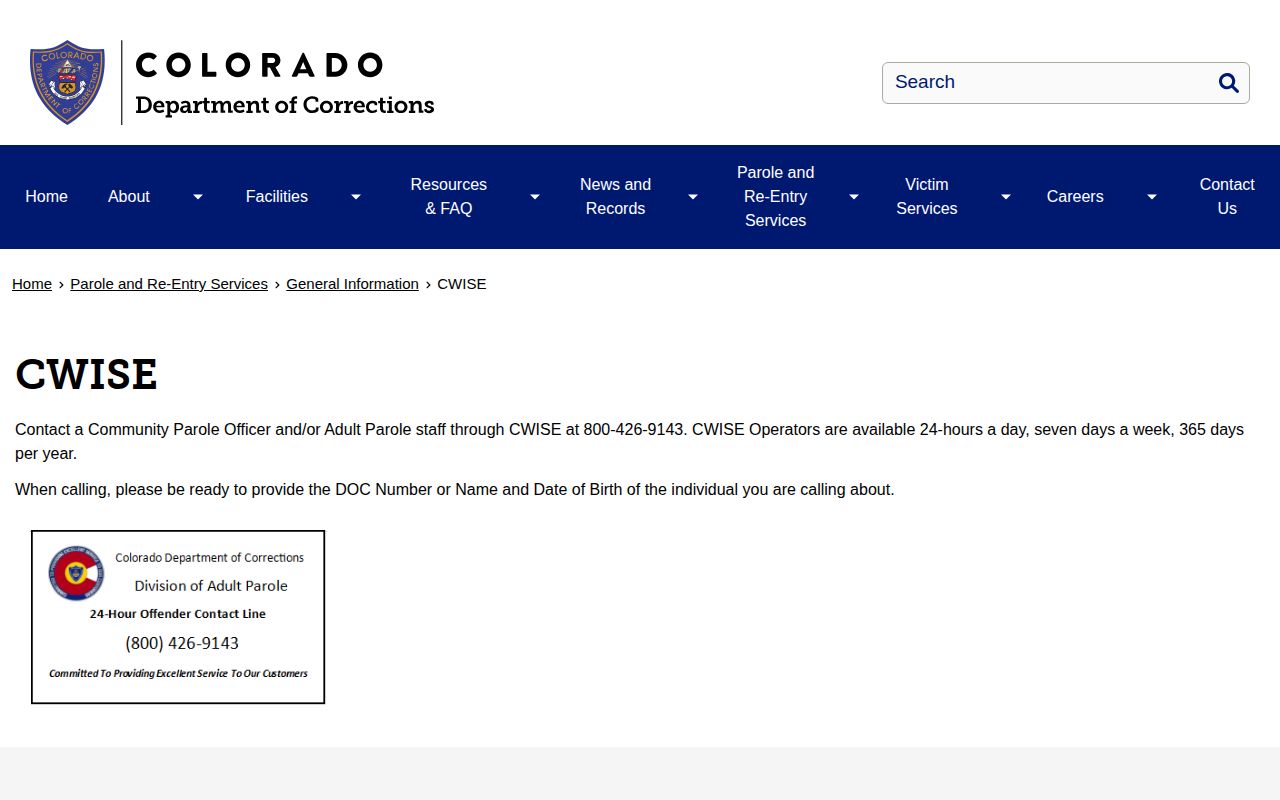
- For parole supervision questions, call CWISE at 800-426-9143 with the DOC number or the person's name and date of birth. CDOC describes CWISE as available 24 hours a day, seven days a week, 365 days per year.
- For probation questions, search the Sedgwick Combined Court docket and request the disposition, probation order, revocation order, or termination order from the court if the public docket is incomplete.
- Use Colorado VINE for custody-status notifications when the person is still visible in the VINE system. VINE is useful for recent custody changes, but it is not a complete historical parole or probation file.
When the public CDOC result conflicts with what a family member, employer, or news post says, rely on the original custodian. CDOC's disclaimer says users should contact CDOC to confirm information because database information may sometimes be inaccurate. Court-record errors go to the court. Jail release errors go to the sheriff's records custodian. CBI registry errors use CBI Program Support, not the jail or parole office.
Sterling Parole Office for Sedgwick County
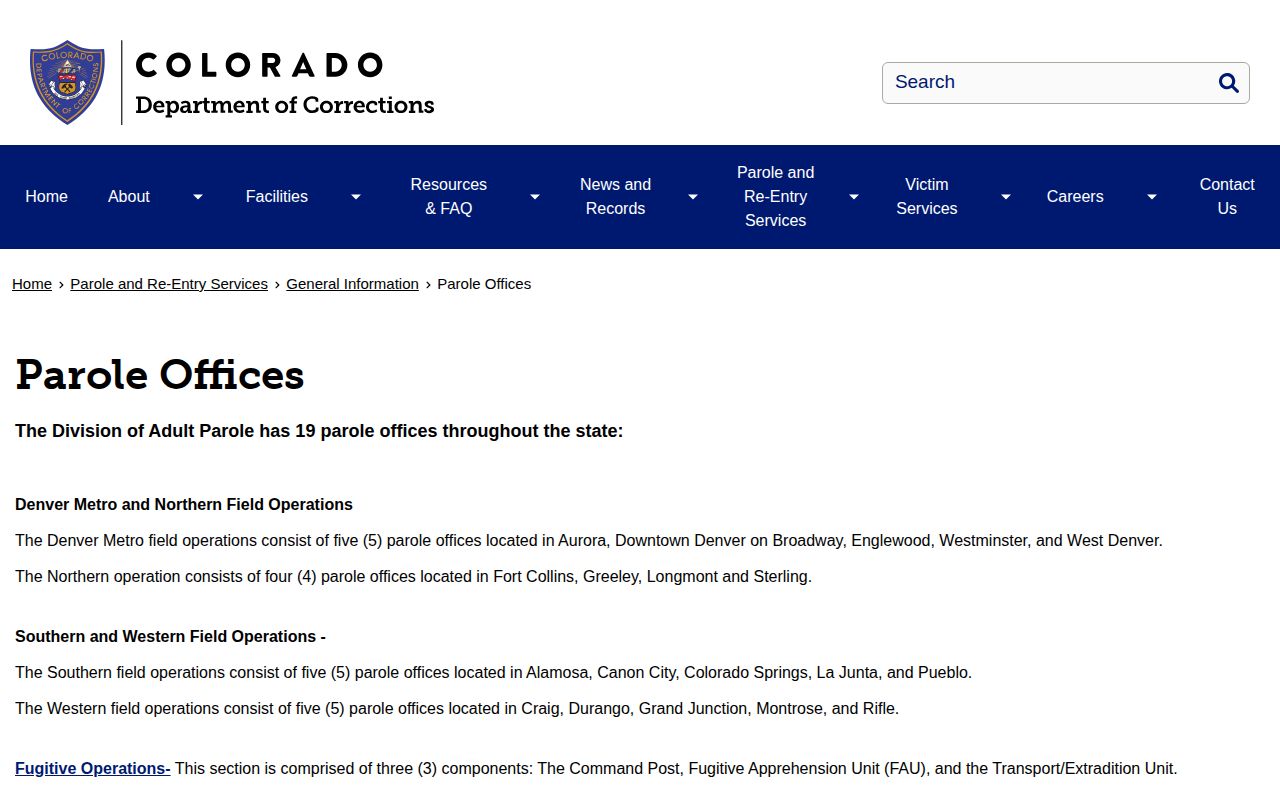
Sedgwick County's local post-release supervision detail is not a Sedgwick County parole office. CDOC lists Sterling in the Northern parole operation, making the Sterling Parole Office the practical regional office for northeast Colorado residents. This matters because a released state prisoner may live in or return to Sedgwick County while the supervision file is handled through a regional CDOC office rather than the county sheriff.
Colorado Adult Parole Contact Points
Adult Parole headquarters: Colorado Department of Corrections, Parole and Re-Entry Services, 1250 Academy Park Loop, Colorado Springs, CO 80910. Phone 719-579-9580. Email cdoc@state.co.us.
Sterling Parole Office: 226 N. 3rd Street, Sterling, CO 80751. Phone 970-522-7815. Fax 970-522-7840. Hours Monday-Friday 8:00 a.m.-5:00 p.m.
CWISE: 800-426-9143 for community parole officer or Adult Parole staff contact. Have the DOC number or name and date of birth ready.
The official parole office directory is the best place to confirm office assignments because a person can be supervised outside the county where the original case began. A Sedgwick County resident sentenced to state prison may have been housed at Sterling Correctional Facility or another CDOC facility, released elsewhere, then reassigned based on residence, plan approval, or supervision conditions.
CWISE, VINE, and Parole Records
CWISE and VINE answer different supervision questions. CWISE is a CDOC contact line for community parole officer or Adult Parole staff contact. It is appropriate when the person has a DOC number or enough identifying information to route a parole-supervision question. Colorado VINE is a custody-status and notification service. It can help a victim, family member, attorney, or other purpose-neutral user receive custody-change information, but it does not replace the CDOC offender record, parole-board decision, sheriff release entry, or Sedgwick Combined Court order.
For a person who has just left prison, search CDOC first and then use CWISE or the Sterling Parole Office for supervision questions. For a person who has just left the Sedgwick County jail, use the sheriff, court docket, and VINE while the record is still active. If the jail release was actually a transfer to CDOC, the later parole path belongs to CDOC. If the release was to probation, CDOC parole contacts will not be the right custodian.
Conditions, Violations, and Absconders
A person on parole or probation can be out of jail and still subject to conditions. Conditions may involve reporting, residence approval, treatment, travel limits, no-contact orders, restitution, or compliance with a parole plan or court order. The public record may not display every condition. What matters for release verification is whether the person is in the community, under supervision, wanted for a violation, returned to custody, or discharged.
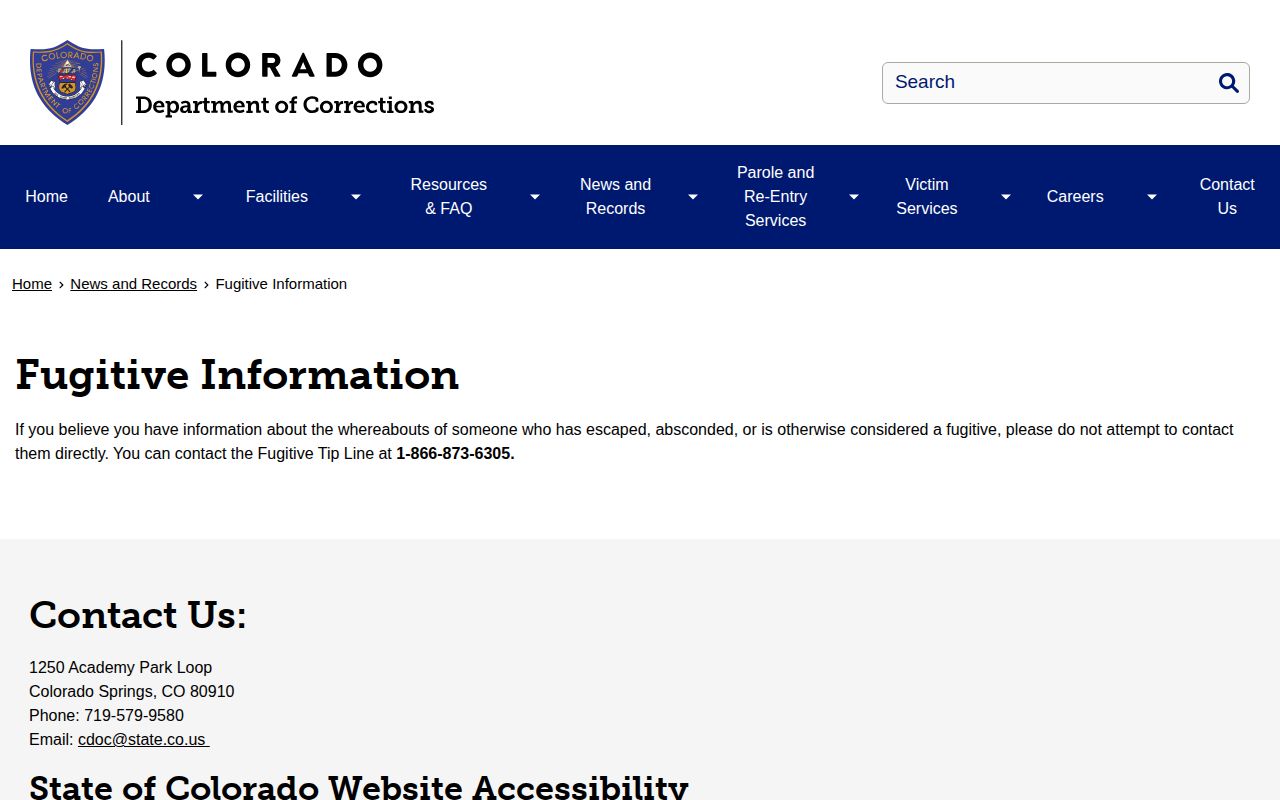
CDOC's fugitive information is important when a parolee is listed as an escapee, absconder, or fugitive. The state page instructs the public not to contact the person directly and provides the Fugitive Tip Line at 1-866-873-6305. For Sedgwick County research, this is the safest way to handle a record that suggests someone is physically outside prison but wanted for supervision reasons. A social media post, commercial listing, or old jail record should not be used to confront someone or make a private eligibility decision.
Probation violations are verified through the court file and probation department rather than the CDOC fugitive page. A Sedgwick Combined Court docket may show a probation-revocation filing, a warrant, a hearing, a sentence change, or termination of probation. If the court file is sealed or restricted, the absence of a public result should not be treated as proof that no supervision exists.
Parole Hearings Are Not Release Proof
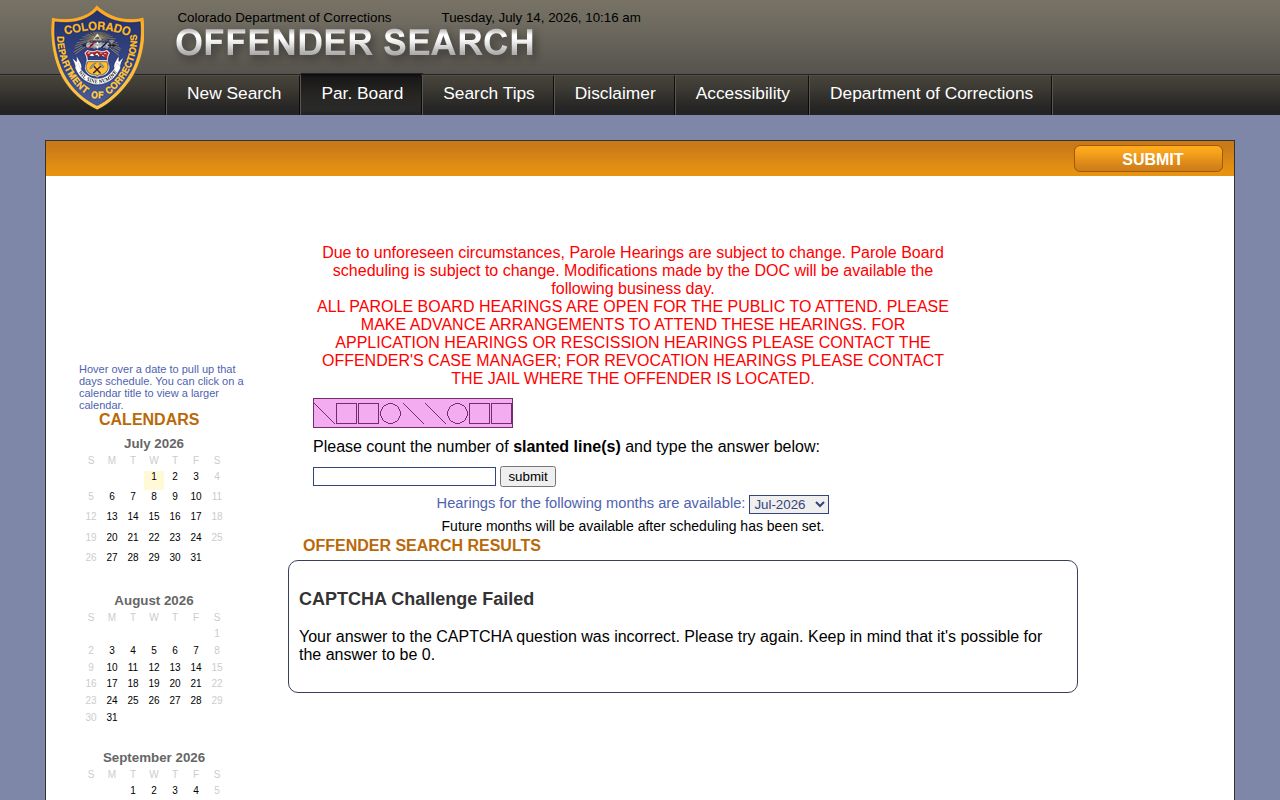
The Colorado State Board of Parole calendar inside the CDOC offender search system can help explain upcoming parole consideration, but a calendar entry is not a release order. The calendar page displays monthly calendars and says hearings are subject to change. It also notes that modifications by DOC are available the following business day and that public attendance requires advance arrangements. Common outcomes can include grant, defer, deny, rescind, revoke, continue, or a later hearing date, depending on the case and record wording.
Use the hearing calendar alongside the individual CDOC offender record. If a record shows a scheduled hearing, ask whether the issue is application, rescission, or revocation. A grant can still be affected by parole plan approval, detainers, misconduct, other agency holds, or later rescission proceedings. A denial or deferment means the person may remain in custody even if a family calculation suggested an earlier date.
How Sedgwick County Supervision Ends
Supervision can end in several ways, and the proof depends on the agency. A parole discharge is a CDOC sentence-control issue. It may appear in CDOC status or date fields, but disputed information should be confirmed with CDOC, Adult Parole, or the supervising office. A probation completion is a court issue. It may appear as a court order terminating probation, a closed case entry, or another Sedgwick Combined Court record.
Colorado public-record rules also affect what remains visible. Criminal justice records can involve custodian discretion, redactions, court orders, juvenile restrictions, and sealing. Colorado Judicial Branch sealing guidance explains that adult sealing can restrict public access, and juvenile records have separate limits. If a public search returns no supervision record, verify spelling, date of birth, county, and custody type before assuming there was no case.
Parole, probation, release records, mugshots, and registries should be read as source-specific records. Use them for release verification, court/legal process, notification, and record correction. For a broader release-record workflow, start with Sedgwick County released inmates and then confirm the specific agency record that created the status.